All American Martial Arts wants to say "Thank You" to the men and women of our armed forces. Their sacrifice, and that of their families, allows us all to enjoy the freedoms of "life, liberty, and the pursuit of happiness." The management, instructors, and students of All American Martial Arts appreciates all you do in the service of us.
We hope everyone has enjoyed a wonderful Memorial Day weekend. If you haven't yet, please say "Thank You" to an active duty service man or woman, or a veteran. But please don't forget their service after this holiday. We have students who have seen their parents deployed and know how this impacts families.
We also want to remind those on active duty that they will never be charged tuition when they train at All American Martial Arts. This is our way of saying thanks all year round.

Monday, May 30, 2011

Wednesday, May 25, 2011
Will your child be doing this over the summer?
Parents,
What will your child be doing this summer? Are they sitting at home, watching TV or playing video games. Or worse yet, wondering the neighborhood with kids you don’t really want them hanging around? Are they stuck in a daycare program that bores them to tears and provides no long-term growth opportunities?
Or, will they be doing something like this:

Or This...

Or This...
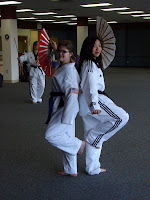
Or even something like this...

At All American Martial Arts Summer Martial Arts Immersion Program, your child will learn valuable life skills, such as courtesy, integrity, and self-discipline. They’ll also learn valuable self-defense skills, including danger awareness, conflict resolution, and the absolute best in youth self-defense techniques. In addition, they’ll stay in shape by participating in physical fitness activities.
This program is designed to immerse your child into the martial arts over an 11-week period. They will learn physical skills, gain insight into the history of the martial arts, and learn how the martial arts can have an impact on their daily lives. At the conclusion of the program, students will receive an official certificate of completion from the International Kong Soo Do Association, and official belt rank from All American Martial Arts.
If your child’s summer doesn’t include learning important, life-changing values, staying physically fit, or learning how to protect him or her self, don’t you think it should? All American Martial Arts’ Summer Martial Arts Immersion Program is an experience your child won’t forget. Contact us today to see how your child can participate in this one-of-a-kind martial arts program.
Get them out of the daycare, off the couch, and away from the negative influences and get them into an environment where they will grow mentally, physically, and emotionally. Enroll by June 1st and get your first week at 50% off!
Tuesday, May 17, 2011
The Power of Concentration

One of the most difficult challenges of modern life is the ability to focus. We often hear about the importance of multi-tasking – doing more than one thing at a time. However, so much of life today seems to be a constant multi-task it is often difficult to get anything accomplished well.
Latin writer Publius Syrus wrote, “To do two things at once is to do neither.” Grandmaster James Ray of All American Martial Arts reinforces this thought with his students when he often says, “The brain can only focus on one thing at a time.” This is an important element to the self-defense strategies he teaches.

Technology has increased the speed of communications in our society, and many have come to believe it should also increase the number of tasks we are able to complete at once. However, the lost art of concentration is a critical ingredient to success. To devote our entire attention to the task at hand, to the goal of most importance, is what allows us to accomplish it successfully.
The Martial Arts are a great way of re-learning or reinforcing the skill of concentration. Katas, board breaking, basic movements, as well as a variety of other activities help focus the mind and clear away distractions. They strengthen the practitioner’s ability to achieve the exceptional by harnessing the mind’s complete attention on the object in front of it.

In self-defense, concentration is important in more than one way. First, you need to be able to concentrate on the attacker and what they are doing. But second, you also need to understand their concentration, or lack of it, can be used against them.
As mentioned earlier, Grandmaster Ray consistently reminds us that the brain can only concentrate on one thing at a time. Therefore, incorporating distraction techniques becomes a very valuable tool in self defense.
"Give them something to think about," says Grandmaster Ray. In other words, take their concentration off their attack. A light tap or kick is all it takes to change an attackers focus and give you the advantage. However, you must be completely focused on what you are doing.

The next time you are tempted to fall into the trap of multi-tasking, remember the words of Arnold Palmer: “The secret of concentration is the secret of self-discovery. You reach inside yourself to discover your personal resources, and what it takes to match them to the challenge.”
Whether it's a multi-million dollar business transaction, a trigonometry final, or defending yourself against a mugger, your ability to concentrate is the key to your success.
Sunday, April 24, 2011
Self-Defense - Keeping It Simple
Too often the image most people have of self-defense is what they see in television programs and the movies. Our entertainment industry can create incorrect perceptions of what effective and realistic self-defense is. It's easy to forget the highly choreographed movements we watch in the movies are created to entertain, not educate.
When it comes to self-defense, we have learned the truth of the saying, "simple is best." Trying to teach an endless number of techniques that are complex and time consuming only increases the chances a student will be injured trying to use them.
It is also important not to abandon common sense. Self-defense is more than knowing how or where to kick and punch. It's also about understanding your surroundings and recognizing potentially dangerous situations before they arise.
In addition to simplicity and common sense, repetition is also important. Self-defense is like any other skill you might learn. To get really proficient requires practice. A lot of instructors can teach you very good techniques. But if they are actually going to be effective, they need to be practiced regularly.
We all can enjoy a good martial arts movie. However, it's important to remember that the keys to good self-defense are simplicity, common-sense, and repetition. These three keys can help you stay safe and secure.
When it comes to self-defense, we have learned the truth of the saying, "simple is best." Trying to teach an endless number of techniques that are complex and time consuming only increases the chances a student will be injured trying to use them.
It is also important not to abandon common sense. Self-defense is more than knowing how or where to kick and punch. It's also about understanding your surroundings and recognizing potentially dangerous situations before they arise.
In addition to simplicity and common sense, repetition is also important. Self-defense is like any other skill you might learn. To get really proficient requires practice. A lot of instructors can teach you very good techniques. But if they are actually going to be effective, they need to be practiced regularly.
We all can enjoy a good martial arts movie. However, it's important to remember that the keys to good self-defense are simplicity, common-sense, and repetition. These three keys can help you stay safe and secure.
Sunday, April 17, 2011
Summertime Safety - Start Planning Now
Summer is just around the corner. School will be out, and young people will be enjoying variety of summer activities. But because so much is going on, summer is also a time when youth are vulnerable to a variety of dangers.
Use the next few weeks to help prepare you and your child for the summer. Here are some helpful tips to ensure your child has a safe, as well as a fun summer:
Use the next few weeks to help prepare you and your child for the summer. Here are some helpful tips to ensure your child has a safe, as well as a fun summer:
- Make sure your child has important contact numbers: With cell phones the ability of children to contact parents or other family members is much easier. But make sure your child has your contact information, as well as that of other family members, friends, and public safety offices.
- Keep reasonable hours: It's not uncommon for kids to get to stay up later during the summer than during school. But this should not be a time for them to have no restrictions. Keeping regular hours will not only help them stay well-rested, it will also help keep them out of trouble.
- Limit time on the computer, play-station, and television: With all the home entertainment options, it's easy for youth to become physically inactive during the summer (one reason why youth obesity is at record levels). Make sure your child gets regular exercise and doesn't let the summer become a time of deteriorating health.
- Teach your child to be aware of their surroundings: It's unfortunately true that summer brings an increase in crime. Help your child stay safe by teaching them how to be aware of their surroundings and how to notice if something is unusual.
- Know where your child is: They don't always appreciate it, but one of the most important things you can do to keep your child safe is to know where they are.
Tuesday, April 12, 2011
Making Good Decisions
“When your values are clear to you, making decisions becomes easier.” – Roy Disney

Have you ever noticed how difficult it is to make important decisions if you are unclear on your priorities? If you’re having trouble choosing between two distinct courses of action, you may want to reexamine your values. It may be a situation in which you simply need to remind yourself of what is most important to you. Or, it may be that you need to revise those priorities based on new information, an important experience, or changing circumstances.
In Taekwondo, we have five chief tenets: 1) courtesy; 2) integrity; 3) perseverance; 4) self-control; 5) indomitable spirit. These are our values. They guide us not only in how we conduct ourselves on the training mats, but also in how we conduct ourselves at home, in school, at the office, and anywhere else we find ourselves. These tenets serve as anchors for our actions.

When these values are at the forefront of our minds, making hard decisions becomes easier. Will the proposed action conform, affirm, or reinforce these values? Then it is easier to choose it. If the proposed action doesn’t conform to these values, it becomes clear it is something we wish to avoid. Regardless, having this clear set of priorities makes decision making more efficient and effective.
Monday, April 4, 2011
Make Sure Your Martial Arts Training is "Self-Paced"
One of the great things about the Martial Arts is that it is a self-paced program. You can progress at the rate you want and are capable of. This means some students will quickly move up levels, while others will progress more slowly. The majority will be somewhere in between. But each student can decide what their rate of progress will be.
But there are some pitfalls to self-paced programs that students (and/or parents) should be aware of. They include:
· Student-to-Student Comparisons – This is when a student begins comparing their progress with others. This can often give a student an incorrect perspective of themselves and others. A student that is progressing rapidly may think they are “better” than other students. While one that is progressing at a slower rate may become discouraged and feel they are not doing well. The martial arts are not a sprint to Black Belt status. In fact they are not a race at all. It’s not important how quickly or slowly a student reaches that point, but that they accomplish their goal.
· Parent-to-Student Comparisons – Parents can also get an incorrect perception of their child’s true development by comparing them to others. Not every student is in the same program. Some are training 5 or 6 days per week. Others train 2 days per week. In addition, some have other activities they are committed to besides their martial arts training. Parents should be cautious in comparing their child to others.
· Self-Paced vs. Testing Cycle – Although the martial arts are self-paced, most schools have an established testing cycle. Some schools test every two months, some test twice per year. We have a three month testing cycle. But testing should not be the only measure of progress. The ability of the student to understand their discipline, to perform techniques correctly, and to be comfortable demonstrating their knowledge is more important than ensuring they test at every cycle. Don’t be afraid to hold a child back from a test to ensure they have truly learned their material.
· Burnout – Because martial arts programs are self-paced, and because when something is new students want to be there frequently, burnout can become an issue. They immerse themselves too quickly, and within a few months they have lost interest. This is why a lot of schools will limit the number of times beginning students can attend class each week. They want the desire to remain.
· Parental Pressure – This is not a problem exclusive to the martial arts. You will find it in nearly all activities. Parents want their child to do well. But sometimes, we become too invested in our child’s performance. When this happens, the child becomes resentful of their training, rather than enjoying it. Parents must be comfortable letting their child progress at their own speed. If you have questions about their progress, visit with an instructor. All children need motivation now and then, but they don’t need unrealistic expectations.
If you watch for these traps, you and/or your child will truly enjoy and benefit from the self-paced of the martial arts. And as always, if you have a question, ask an instructor.
Subscribe to:
Posts (Atom)