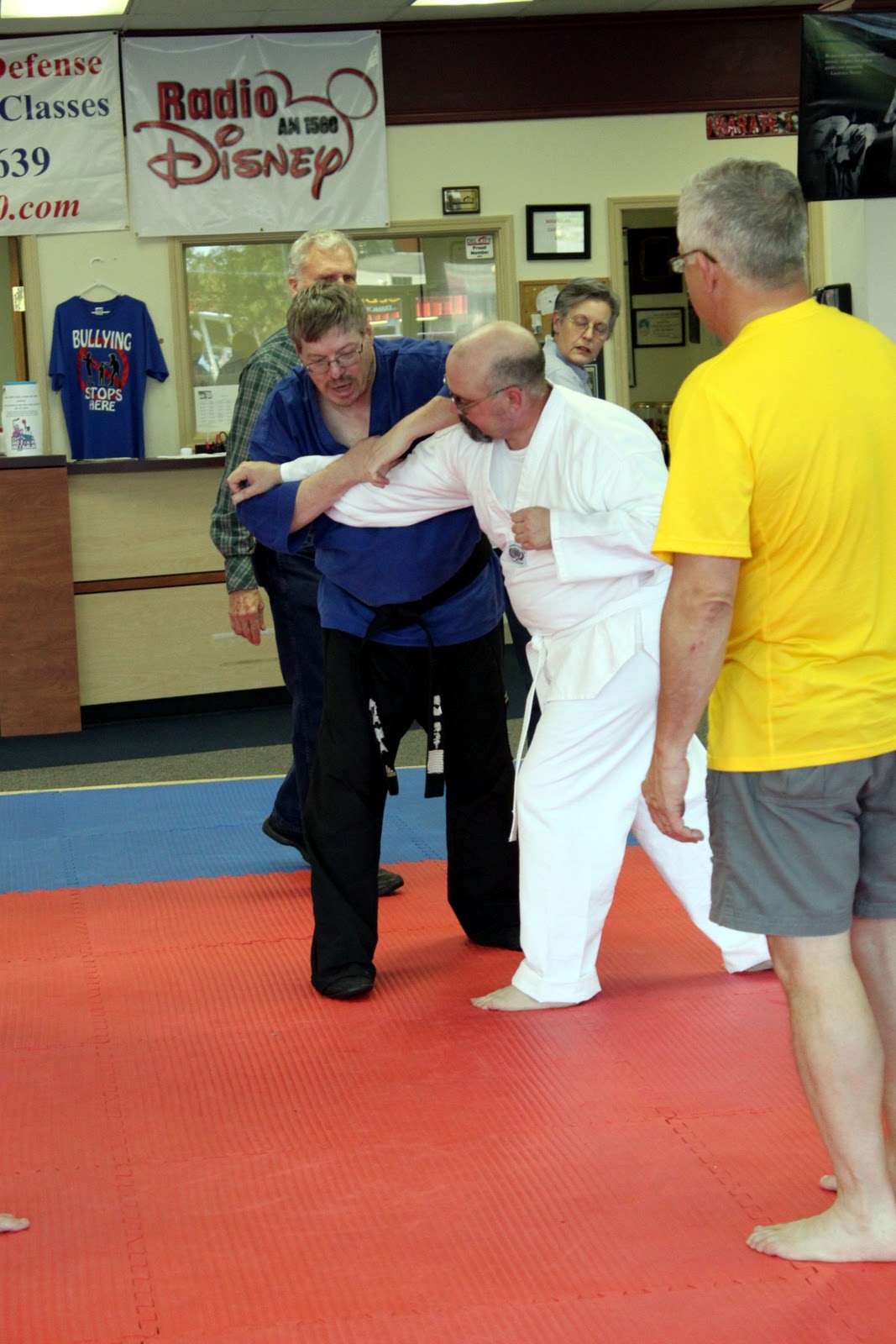
All American Martial Arts Overview

Friday, October 21, 2011

10 Ways to Measure Self-Defense Instruction

A group of our instructors recently attended a training seminar put on by a national organization.  These instructors all have many years of training and teaching experience.  So, like many of these professional development conferences, they not only learned some new things, but also identified some weaknesses in some of the concepts or techniques being taught.

Fresh off this experience, we thought it would be good to offer a guide on how to measure if the self-defense instruction you are being taught is adequate.  Here's our criteria for effective self-defense instruction:
  • Awareness - the first step to effective self-defense is to increase your awareness of your surroundings.  Increased awareness can keep you out of dangerous situations.  It should be a regular part of any self-defense situations.
  • Movement - We have a common saying at our school that sums up our approach to self-defense:  "If you don't want to be hit (or kicked), don't be there."  The idea is to not be a stationary target.  If you can recognize the type of attack you can position your body so you can avoid the attack and deflect the blow.
  • Protecting Yourself - It should be self-evident that self-defense training should be about personal protection.  However, it is surprising that many techniques being taught actually increase the exposure to physical harm rather than minimizing it.  If a technique does this, we don't advise using it.
  • Efficiency - It is unfortunately true that many instructors have forgotten he value of simplicity.  They teach self-defense moves that require many, often complicated, techniques.  Why do something in 8 moves, that you can do in 5?  Or why do something in 5 moves that you can do in 3?  The goal of self-defense is not to show how good a fighter you are, but to quickly and effectively escape or subdue your attacker.  Efficient techniques are the best.
  • Effectiveness - It should be obvious that a good self-defense technique is one that actually works.  However, some instructors spend time teaching techniques that simply don't work.  Here's a good tip on identifying a problem with the technique:  if the instructor is consistently the only one in class who can adequately perform the technique, it's probably not very effective.
  • Capability - Self-defense instruction should be tailored to the actual ability of each student.  If you are over 40, you're probably not going to be doing a bunch of spinning heal kicks, or leg sweeps.  Teaching techniques that students can actually perform in a real-life situation is a must for self-defense instruction.
  • Practice - The old saying that "Practice makes perfect" is especially true for self-defense.  Simply coming to class a couple of times per week and learning a technique in a carefully managed situation isn't adequate for really mastering self-defense.  Working at home, practicing with a spouse, sibling, or friend, and experimenting with the technique in a variety of situations is what will allow you to truly understand how and when to use it.
  • Simulate Reality - At some point, it is important to practice the technique in way that will simulate reality.  Speed is one of the most effective ways to do this.  Constantly working on performing the technique as quickly as possible, and in as many situations as possible, will give you the confidence that you will be able to use it if attacked for real.  If your training is always in "slow motion" you are not being adequately prepared for reality.
  • Responsive Instructor - Although an instructor has to manage the class and ensure that they are able to teach the lesson on time, they should not shut down questions.  If they can't take the time during class, they should make time after class.  If an instructor consistently ignores or avoids questions, it's a good sign they are not fully confident in what they are teaching.
  • Common Sense - Rule #1 of Effective Self-Defense:  Don't abandon your common sense.  If something seems dangerous or ineffective, it probably is.  If it seems overly complicated, it probably is.  If you're being taught techniques that are outside your physical abilities, that's not good instruction. 
There are a variety of martial arts disciplines and all have something valuable to offer.  However, regardless of discipline, these 10 guidelines should be used to judge the true value of the self-defense instruction being taught.  If you have any questions regarding self-defense instruction or would like to know more about the self-defense techniques taught at All American Martial Arts, contact us at (405) 601-0639 or by e-mail at aama2010@usa.com

Friday, October 14, 2011

Top 10 List for Choosing a Martial Arts School

At All American Martial Arts we recognize that not everyone has the opportunity to train at our facility.  So we thought we'd provide a "Top 10" list to help you choose the right Martial Arts school for you.  We hope you find it useful and enjoyable.  And, if you are looking for a school in our area, please come compare us against our checklist.
  • Friendly & Courteous Staff - Does a staff member greet you and offer assistance when you enter the door?  Do they show an interest in you by asking questions?
  • Professional Instructors - Do the instructors manage their classes well?  Do they know what they are teaching?  Do students respond well and enjoy the classes?
  • Family Friendly Environment - Regardless whether just you or a child is training, or if the whole family is, does the staff create an environment that welcomes your family and friends and treats them with respect?
  • Convenient Schedule - Does the school offer a variety of classes at times that can fit your schedule.  These may include early morning or daytime classes, as well as traditional evening programs.
  • Multiple Programs - Does the school offer a variety of training programs that can enhance the students' experience as they progress?  Do they have different programs for youth and adults?
  • Appropriate Facilities - Is there enough space to adequately train?  Is the facility clean?  Do they have an area for parents with small children to watch the floor?  Do they have enough training equipment?
  • They Expect a Commitment - Many schools will lure you in with the "No Contract" appeal.  Here's what we know - a school that doesn't expect a commitment from you, will not make a commitment to you.  They are out for the "fast buck" and have little concern about your progress.  Look for a school that expects a commitment from you.  They'll give more to you in return.
  • They Emphasize Life Skills in Classes - This is especially important for younger students, but also adults.  The Martial Arts have been and should be about more than just kicking and punching.  A school that fails to embrace the character-building nature of the Martial Arts is giving its students tools, but no guidance on how to properly use them.
  • They teach practical, effective, Self-Defense - At All American Martial Arts we believe every discipline has something of value and can be learned from.  But when it comes to self-defense, we believe practical, real-world techniques should be taught.  Schools that ask you to abandon your common sense, or teach overly complicated techniques make harder to defend yourself.
  • Demonstrate Value - Whether it's in their youth or adult programs, self-defense or competition programs, or enhanced programs like a black belt clubs or master clubs, the school should be able to clearly demonstrate that you are getting good value for the time and money they are asking in return.
If you have any questions or would like to know more about how to choose a good martial arts school, please feel free to contact us at (405) 601-0639 or by e-mail at aama2010@usa.com.

Monday, September 12, 2011

Two of the Bravest Young Men I Know

When we think of bravery, we often think of members of the military, police, firefighters, and first-responders.  After the 10th Anniversary of 9/11, this is not surprising.  However, I'd like to introduce you to two of the bravest young men I know.

They are not old enough to serve in our military or in law enforcement.  But they have fought an enemy that is insidious, relentless, and devastating.  Ian Black and Ethan Henry have not reached their 10th birthdays.  Yet they have fought a battle that would terrify most adults.

Both of these young men have battled cancer at their young ages.  Both have triumphed.  We at All American Martial Arts have been privileged to be a part of their success.  We have seen the progress they have made not only physically, but mentally and emotionally as well.

Now we want to solicit you into the fight against childhood cancer as well.  We have partnered with these two families to participate in the Oklahoma City CureSearch Walk on September 19th.  This event will raise funds to find cures for various forms of childhood cancer.

Ian and Ethan were fortunate to have good medical care, stable families that provided support, and access to physical and mental rehabilitation through the martial arts.  But not every child who is struck by cancer has these assets.

We're asking you to join us in defeating this horrible disease that strikes at too many of our children and families.  Our goal is to raise $1000 for this effort.  You can contribute by going here.  Your donation will help children across our state have the same chance as Ian and Ethan.

If you have any questions, please contact All American Martial Arts at (405) 601-0639 or by e-mail at aama2010@usa.com

Monday, August 29, 2011

Bullying Stops Here!

On Tuesday, September 6th, we're taking bullying head on!  The new school year isn't even a month old and we have already received reports of bullying.  So we're bringing back our Bullying Stops Here seminar and have created a single day camp for students to attend. 

This camp will focus on several important aspects of bullying.  First, we'll supercharge participants' self-confidence.  Children with low self-esteem are much more likely to be victims of bullying.  And children who have been bullied will have trouble gaining self-confidence.  It's a vicious cycle that we are going to break.


We'll also explain why some students try to bully others.  It is important for students to understand the mindset of a bully so they are not intimidated by them.  Once you remove the "mask", bullies aren't nearly so fearsome.

Then we're going to give participants a 3-step process to end bullying behavior by others.  This process will give students control over their situation.  It will allow them to understand how to end bullying effectively.  And it will keep them safe.

We're also going to provide students with the absolute best in youth self-defense techniques.  Like other parents, we don't want our children to be involved in fighting.  But we also don't want them to be helpless victims to bullies, either.  The fact is, these techniques, like those we teach every day, aren't "fighting techniques."  They are techniques to end a physical confrontation as quickly and effectively as possible. 

In addition, we're going to help participants increase their awareness and recognition skills.  Students can stay safe and avoid confrontations by increasing their ability to see a problem before it occurs.  We'll help them understand their surroundings and learn to identify potential dangers before they are entangled by them. 

We're also going to address two other important aspects to student safety and self-defense.  The new phenomenon of "pack bullying" - where groups of students roam a campus looking for victims - and surprise attacks.  It's unfortunate that sometimes, no matter how prepared someone is, they can be attacked by surprise.  We're going to help participants understand how to deal with surprise attacks and how to think clearly even if they have been hit first.

This seminar is a must attend event if you have a child in school.  Some schools are out on September 6th, so they won't have to miss school to attend.  But even if school is in, we recommend you consider having your child attend this important event.  It very well could be the most important thing your child learns this year.

You can register for this event by clicking here.

Tuesday, July 26, 2011

Black Belts in Business Part I: Self-Confidence

People often view the martial arts as simply a youth activity.  But the reality is there are many useful benefits and applications that can be taken from the martial arts and used by adults as well.  Over the next few weeks, we’ll explore how the martial arts can improve your performance in your professional life.  Whether you are a small business owner, employee, or chief executive officer of a major company, there are many aspects of the martial arts that can help you improve your personal performance as well as the performance of your team.

One of the most important and impactful characteristics gained through the martial arts is self-confidence.  Regardless of your age or profession, self-confidence is a key ingredient to success.  The self-confident employee is going to be more likely to make suggestions to their supervisor for process improvements.  The self-confident small business owner is more likely to take the necessary risks that will create long-term success for their business.  And the self-confident CEO will more easily gain the trust and respect from employees during times of change.

The martial arts offer a great way to help individuals increase their self-confidence.  Activities such as board breaking are great for helping individuals feel empowered and conquering a sense of the unknown.  In addition, forms, belt promotions, and even the physical fitness aspects of martial arts training allow individuals to feel better about themselves and what they can accomplish.  And every good martial arts school will remind their students that what they learn on the mats should impact other areas of their lives, as well.

If you, an employee, or co-worker is struggling with low self-confidence, consider the benefits of a martial arts training program.  Not only will the individual gain from it, but so will your business.

At All American Martial Arts, we're making it easier than ever to find out if the martial arts are right for you.  Our summer special offers individuals a low-cost, short term opportunity to learn the benefits and fun that are a part of martial arts training.  And as always, we offer two free lessons to anyone interested.  Come find out why we say we offer a "Whole New Martial Arts Experience!"

Thursday, July 7, 2011

Are you looking for daycare or "childcare" in your after school program?

Parents, school is coming soon.  In the Mid-Del area, school begins August 11th.  In some areas of the metro, school will begin even sooner.  If you have a school age child between the ages of 5 and 13, and you have them in a daycare provided after-school program, we have good news for you – there’s a better alternative!
Here are a few simple reasons you should strongly consider enrolling your child in our martial arts after school program:
·         Life Skills/Character Education – from learning how to increase their focus, to gaining self-discipline and understanding the importance of respect and perseverance, the martial arts are an excellent mechanism for reinforcing those values that will help your child succeed in every area of life.
·         Anti-Bullying/Self-Defense – In previous posts we’ve catalogued the most recent statistics for bullying in both the U.S. and Oklahoma.  None of us wants our child in a physical confrontation.  That’s why we teach our students appropriate conflict resolution techniques.  However, if attacked, none of us should expect a child to be a victim either.
·         Physical Fitness – The simple fact is child obesity continues to remain at near-epidemic levels.  With school budgets continuing to be cut, physical education programs are becoming less of a priority.  The martial arts are a great way for your child to develop physical as well as mental fitness.
·         We’re not going to talk about how many stars we have – Let’s be honest, daycares spend a great deal of time qualifying for, and then promoting their rating (stars) from DHS.  But we all know that meeting minimum state regulations does not translate into true “childcare.”  At All American Martial Arts, we’re going to spend our time talking about the growth and improvement your child can make physically, mentally, and emotionally through our program. 
·         Pricing – The reality is this program is far superior to most after school programs, and we could charge significantly more for it.  However, we have chosen to keep our price down in order to make it affordable for most families in our community.  In some cases, our cost is actually lower than daycares in the area.
·         Daycare vs. “Childcare” – If you need after school care for your child, consider what truly constitutes quality childcare.  Is it the number of stars a facility has?  Is it sitting at a table coloring or drawing for 3 hours?  Or would true childcare include important character education, physical fitness instruction, and self-defense training? 
If you believe the latter is more reflective of true “childcare”, than you need to call us TODAY to enroll your child in our after school martial arts program.  It truly is the absolute best alternative for families needing after school care for their children. 

Tuesday, June 21, 2011

Are you a good teammate?

"Individual commitment to a group effort - that is what makes a team work, a company work, a society work, a civilization work." - Vince Lombardi

At All American Martial Arts we have four current students who have earned the title "National Champion" from the Amateur Athletic Union's National Taekwondo Championships.  One has earned that title twice.  However, they will be the first to tell you it was a team effort that made that accomplishment possible.

Instructors, family, sparring partners and others all contributed to the effort that allowed them to compete and win at the highest level.  But the same is true of every other area of our lives.  Author and leadership expert John Maxwell has said, "No great accomplishment has ever been achieved by an individual."  We all have teams around us.

In visiting with young students, we often remind them that their families are teams also.  We help emphasize the importance of being a good "teammate" at home.  The same is true for adults as well.

Whenever we hear the word "team" it is natural to think of our favorite sports team.  However, the same principles that help those teams to win championships are necessary for us to achieve success at home, at work, and in society.

Personal sacrifice, commitment to a common goal, dedication to improve, accountability, and perseverance are all attributes we see in championship teams, whether they be a football team, a major corporation, a community organization, or a family.

How well your team performs will be determined by the integrity each teammate displays towards achieving team goals.  What kind of teammate are you?  Do you display the characteristics of a champion in your daily life?  Or do you just try to get by, only worrying about how to improve your personal position in the organization?

The first step in building a good team is dedicating yourself to being a good teammate.  Want to create a winning team at home, at work, and in your community?  Commit yourself to being the best possible teammate.  Doing so will inspire others to do the same.  Before you know it, you will have achieved those goals, too.  And you can truly lay claim to the title "Champion."